Showing posts with label The Rolling Stones. Show all posts

Monday, 5 December 2011

5 Legendary Recording Studios

1. Abbey Road - London, UK


Probably the most famous recording studio in the world due, in no small part, to the fact that The Beatles named an album after it. They recorded almost all their albums and singles there between 1962 and 1970 and are synonymous with the studio and it's nearby zebra crossing. But it wasn't just The Beatles who recorded here. Other famous recordings made here include;
  • "Living Doll" - Cliff Richard
  • "Apache" - The Shadows
  • "Ghost Riders In The Sky" - The Scorpions
  • "The Dark Side Of The Moon" - Pink Floyd
  • "Duran Duran" - Duran Duran
  • "The Bends" & "Kid A" - Radiohead


2. Hitsville USA - Detroit, Michigan, USA

In 1959 Berry Gordy bought this former photographer's studio and converted it into the headquarters for his Motown label along with the label's own studio. At it's peak it would stay open 22 hours a day, closing between 8am and 10am for maintenance. The house band known as "The Funk Brothers" are said to have played on more number-one records than The Beatles, Elvis, The Rolling Stones, and The Beach Boys combined. Artists to have recorded here include Diana Ross & The Supremes, The Four Tops, The Jackson 5, Stevie Wonder, Gladys Knight & The Pips, Marvin Gaye and Smokey Robinson.


3. Muscle Shoals - Sheffield, Alabama, USA
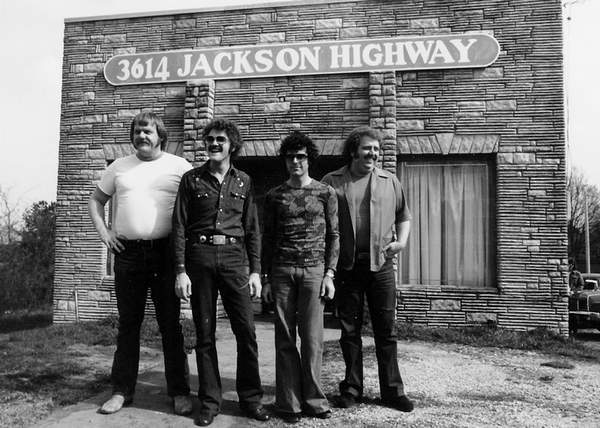

Formed in 1969 when legendary session musicians Barry Beckett, Roger Hawkins, Jimmy Johnson and David Hood, known as "The Swampers" left FAME Studios to create their own studio. Their distinctive accompaniments and arrangements have been heard on a number of legendary recordings, including those from Wilson Pickett, Aretha Franklin, The Rolling Stones, Paul Simon, Lynyrd Synyrd and more recently, The Black Keys. If you're wondering where you've heard about Muscle Shoals and The Swampers before then have another listen to Sweet Home Alabama


4. Studio One - Kingston, Jamaica


Studio One was founded by Clement "Coxsone" Dodd in the late 1950's and became known as the "Motown of Jamaica". It was hugely responsible for the catapulting of Jamaican music into the world scene. Through innovative producers like Dodd, Prince Buster and Lee "Scratch" Perry the studio oversaw the evolution of Ska to Reggae to Dancehall. Almost every Jamaican musician of note recorded here including The Skatalites, Bob Marley & The Wailers, Burning Spear, Toots & The Maytals, Delroy Wilson and Sugar Minott.


5. Hansa - Berlin, Germany 


Hansa Tonstudio in Berlin became legendary in the 1970's when David Bowie went there to record his album, "Heroes", with the help of Brian Eno. It became known as "Hansa by the Wall" or "The Great Hall by the Wall" in reference to the fact that it was right beside the city's infamous partition. It wasn't long before many of the big names in music flocked there to record. Some of those included Iggy Pop, U2, Nick Cave, Depeche Mode and in more recent years, Snow Patrol, Supergrass and REM.


Friday, 25 November 2011

The Bo Diddley Beat


Bomp, Ba-Bomp-Bomp, Bomp-Bomp!


Following on from my recent review of Willy Moon, who's song "I Wanna Be Your Man" is based on this classic Rock & Roll rhythm, today we're going to learn about "The Bo Diddley Beat"


In 1955 Bo Diddley released a song called, funnily enough, "Bo Diddley". The song was under two minutes long but would go on to shape the music we listen to today. It's hard to comprehend now but when people first heard this song it was unlike anything they had ever heard before. Bo used his electric guitar to play Rock & Roll over an African juba beat. He said he first heard the beat in a church in Chicago. But variations of it were to be found in several places. The children’s game hambone used a similar rhythm, and so did the ditty that goes “shave and a haircut, two bits”. This now distinctive "Bomp, Ba-Bomp-Bomp, Bomp-Bomp" was massively innovative and would be used in countless songs for years to come.


Next time you see Westlife on TV don't change the channel. Take a deep breath and listen until about two thirds of the way into any one of their songs. Up to this point you will have noticed four men in white/black/grey sitting on four evenly place stools in the centre of the stage. Small dark-haired lad singing mostly, tall dark-haired lad doing his bit, two blonde lads looking contemplatively to the side. But any second now we'll see what we've been waiting for. A momentary pause in the music, a single beat of a drum and the four lads with undoubtedly rise in unison from their stools. What you just witnessed was the infamous key change. A musical device adored by pop song writers the world over. The key change creates an excitement in the song through the sense of tension and release. In "Bo Diddley" however, there is no chord change whatsoever. This song gets it's excitement from the rhythm of the drums and guitars. It was so catchy it became known as the Bo Diddley Beat.


On 20th November 1955 Bo Diddley appeared on The Ed Sullivan Show. Sullivan wanted Diddley to play a song, "Sixteen Tons," but without telling Mr. Sullivan, Bo played this ground-breaking song anyway, which didn't go over well with the host. Afterward, in an off-camera confrontation, Mr. Sullivan told him that he would never work in television again. Bo Diddley did not play again on a network show for 10 years.


The Bo Diddley Beat became one of Rock & Roll's bedrock rhythms. Some of the more famous uses of the rhythm include;


Thursday, 6 October 2011

The Magic Formula


Researchers at Goldsmiths University in London have recently published a study they conducted on the "catchy-ness" of certain songs. In their study researchers observed how volunteers reacted when asked to sing along to different songs, and found out that long and detailed musical phrases, multiple pitch changes in the main hook, a male vocalist, and preferably a high pitched male vocalist, all helped make songs catchy. 

Goldsmiths music psychologist Dr Daniel Mullensiefen says "Every musical hit is reliant on maths, science, engineering and technology; from the physics and frequencies of sound that determine pitch and harmony, to the hi-tech digital processors and synthesizers which can add effects to make a song more catchy". 

Of the songs they tested, the top 5 catchiest songs were:

  1. "We Are The Champions" - Queen
  2. "Y.M.C.A." - The Village People
  3. "Fat Lip" - Sum 41
  4. "The Final Countdown" - Europe
  5. "Monster" - The Automatic

All pretty catchy songs you'd have to agree. I wonder will it lead to finding the magic formula for creating a hit song?

Johnny Bottles has been conducting his own research though and I think I might have cracked it. It's all in the opening guitar riff. Do what you like after that but if you get the start right then you're sorted. 

What guitar riff you ask? Ah, well have a listen to the start of these four songs then get writing!!


"Bohemian Like You" - The Dandy Warhols

 
"Little Bitch" - The Specials


"Brown Sugar" - The Rolling Stones


"Strutter" - Kiss